Friday, October 21, 2005

Photo Friday - Retro -Villa Kerylos

The Photo Friday theme is Retro this week.
I couldn't think of anything more retro than the Villa Kerylos; a villa in Beaulieu-sur-Mer built and furnished in the style of an Ancient Greek palace for Theodore Reinach.

This is one of the rooms - i have to say that this is one of the most breathtaking houses i have ever seen -the attention to detail is unbelievable. There are magnificent wall paintings, tapestries and mosaics and the specially designed furniture is stunningly beautiful.
Its hard to believe that this villa was only built between 1902-1908.


Wednesday, October 19, 2005

Tags and accidental Vandemar activity

Recently i've had a few folk tagging me to do some bloggery list things - Emily
though i wasn't sure how to work out that one, Joli Noir Perle and Constant Thing.
Anyway, here goes:

20 random things

I have synaesthesia which means i can taste some sounds and certain colours and textures and hear some colours .
I didn't realise this was odd until relatively recently.
I'm ambidextrous
I don't drive
chewing gum revoltes me
I am really messy
I can read upside down
People always assume i'm a vegetarian or vegan
Strangers tell me all about their illnesses and hidden secrets
I've seen the Northern Lights
I hate shopping for clothes and loathe shoe shopping even more.
I really dislike clothes hangers
I love watching the sunrise
If i don't paint for a while i get withdrawal symptoms.
I have really bad vertigo
Fortean phemonena have always fascinated me particularly the idea of spontaneous human combustion.
I feel at home underwater
I try to take my camera with me everywhere.
Insects and parasites fascinate me [see photos below]
I last ate bread in 1999 [allergy to grains]

The idea of these things is to pass them on however i think just about everyone will have already done these- so anyone who wants to write about some random stuff plus Sybille ,
Leah


I have been trying to catch some flies on camera recently but had been thwarted by some strong winds recently that meant the fly flew before i managed to get a decent shot of it.

Today has been cold and wet and i noticed that a couple of small flies [under one centimetre] had taken refuge in our house by the window.
So i had to try and take some photos.


I was quite pleased with how things were going , when i accidently squished the fly and it dropped dead. Normally flies are pretty robust so maybe it was already fragile.
I had already been thinking about Mr Vandemar and Mr Croup and 'peepers and tarrywags' as somehow the idea of these blog tags started off taht chain of thought, so the it was really rubbed in , or should i say rubbed out, when the fly dropped dead.

Still I took some more photos of the corpse and let the friend escape out the window.

The wings were magnificent with rainbow shimmers on the transparent parts.

You can see the hairs on its body quite well. I'd like to photograph some blue or green bottles but they don't seem to be around at the moment after being incredibly annoying all summer.


Tuesday, October 18, 2005

four sunrises in a row

I collect sunrises the way other people save stamps .
I've been lucky enough to live beside the sea and have the priviledge of seeing the sunrise frequently during the winter [usually while taking my kids to school] .

I am not by any means a morning person - and with chronic insomnia i am very much a night owl, however that doesn't mean that i forget about the beauty of the sunrise.

It shocks me that people can walk past this awe inspiring spectacle without a sideways or upward glance. Even seeing people taking photos of the sunrise doesn't seem to rouse people from their tunnel vision.

I don't always wait for the sun to fully rise - i just like to get a flavour of the sunrise when i can. This sunrise was very cloudy so the sun itself was unlikely to appear , however the flame orange light was dramatic and brooding.
You can see that despite the deep orange glow; the street lighting and lighting around the port was still functioning.


This was an almost cloud free morning - and more of a baby blush colour than the drama we see with clouds and threatening rain.
The sun is just about visible through the yacht masts in the first picture.

The sun very definitely making an appearance.
Another day, another sunrise. Some flecks of clouds across the sky; delicate , like the inside of shells. The cloud was very thick across the sea so this was some of the sunlight pinking up the free areas of sky.

This morning, the sky was covered in thick cloud but somehow some intense colour was esacaping; bathing the sky in lilac and peach light.
It was the sort of light landscape painters dream of, in fact, the kind of light that drew so many famous artists to the French Riviera.

Clouds, through the trees, looking like cotton wool dipped in pastel inks.


snails and more snails

Its amazing how diverse snails can be when you start really looking at them. I've spent a couple of days taking photos of snails in one particular bird of paradise plant which has attracted hundreds of snails to its leaves.

I have no idea why this particular plant is so attractive, as there are plenty of other bird of paradise plants in the vicinity which don't have snails all over the leaves - its a mystery that only the snails know the answer to.


The shells are interesting -some are very flat , others with very faint patterns and others are very bold and exotic looking.
I don't have any books that identify snails by their shells so I've been trying to identify these on the web- with a wee bit of success. One major problem with identifying snails form pictures is that they can be very different within the same species.
Still i think the shape and colours are really interetsiung, even if i don't have a clue what they are called.


I think this one is most likely the European Brown garden snail Helix aspersa -petit gris in French -which is edible.
The escargot de bourgogne, Helix aspersa or Roman snail is the one most commonly eaten here- its quite a lot bigger so i suppose more meaty for those who like snails.

I thought these two snails snuggled into the curled end of the leaf looked like twins or peas in a pod.

These three were obviously the same kind of snail - the shells were very flat -however i haven't managed ot work out which species they are.


Friday, October 14, 2005

Illustration Friday - Cold- Snow Queen

Illustration Friday is 'cold' this week.

At first i was pondering on penguins and some of the arctic whales for the idea of cold this week but this week I felt i wanted to do something more fanciful.

It didn't take long to come up with a real idea since I had been thinking about the story of the Snow Queen earlier in the week. It seemed obvious that she would make a good painting for the idea of 'Cold.
She was of the ice; clothed in Ice and snow and had the coldest heart, made of solid ice. I wanted to play with the extremes of facial features and make her face look as much like an icicle as possible, without going over the edge into cariacature. I also wanted her to remain beautiful since the Snow Queen is coldly beautiful - as beautiful as an iceberg or glacier. She is the very opposite of queens such as the Queen of Hearts who seem comfortably rounded, bustly and smelling of warm kitchens and baked tarts filled with jam.

I think i've made her more sympathetic than many people because i can see why she wanted the company of Kay; why she craved a warm and clever child to help her pass the time in her castle of ice. Of course she could only keep him by half changing him to ice and removing the bits of him that had appealed to her in the first place.
When i first read the story of the Snow Queen, I think i empathised very much with Gerda - the older and wiser sister who had to rescue the younger brother from himself. I think my youngest sister was born around that time [I'm the oldest of four girls] and i think the idea of a resourceful older sister was something i felt i had to live up to.


Photo Friday - conspicuous

I was puzzling over this topic for quite a while - couldn't think of anything that summed up conspicuous until i thought of this image taken at this years Bataille des Fleurs.

I liked the juxtaposition of the normally dressed people and the flamboyantly feathered dancer who had strayed from the rest of her group somehow.


She looks a lot less conspicuous in the procession with other exotically costumed folk.


Tuesday, October 11, 2005

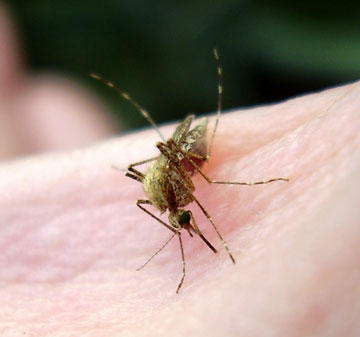
Feasting mosquito

Yesterday when i was taking photos of the bird of paradise flower [and also some snails hiding within the leaves], I noticed a mosquito had landed on my hand and was starting to drink my blood.
I took a couple of shots of it before brushing it off and they turned out remarkably well. It probably helps that I'm ambidextrous.


I think its an Aedes sp mosquito since it had a pointed abdomen and has short palpi. A palpus is a sticklike something found near the mouth parts of insects , arachnids, etc and is thought to be related to food gathering and sensing the environment.

Only female mosquitoes suck blood- they require blood meals for egg production although they may also eat nectar. Male mosquitoes often don't eat before reproducing and dying ; but if they live long enough, they only eat nectar and fruit juices.

Mosquites find their prey by sight [to a limited extent] , smell , carbon dioxide concentration [from exhaled breath] and heat detection. Mosquito repellents apparently block the sensors and prevent the mosquito from finding their victims.

The feeding parts of a mosquito are not really like a hypodermic syringe as is popularly believed. They are actually serrated in order to minimise pain sensation in the victim and in order to cut through the surface layers of skin. Mosquito saliva contains an anticoagulant , which prevents the blood clotting when the mosquito reaches the blood and drinks. The saliva is also the cause of the localised swelling and redness as many people are sensitive to the saliva.

Mosquito saliva may also contain parasites [malaria] and viruses [west nile virus, dengue fever] and because of this mosquitoes have killed more humans than any other creature in the history of the world.


Monday, October 10, 2005

Birds, Birds and more Birds

Three kinds of birds in one day - though not all of the feathered variety.


The first birds of the day were Collared doves, Streptopelia decaocto.
I am fond of these birds - with their smokey grey feathers and sweet cooing. They always look well groomed and clean; feathers are always smoothed down beautifully , their eyes gleam with health and they seem really peaceful. I know that white doves are seen as the symbols of peace but they don't quite have the gentle air of collared doves.

I was trying to get some decent photos without startling the birds , so one looks headless as it pecks up something to eat.
Bird number two is the Bird-of-paradise ,Strelitzia reginae.
This is a South African plant related to the banana [Musaceae family] and it looks somewhat like a crane or stork in profile and not much like bird of paradise birds, which rarely have crest feathers or long pointed beaks..
This is the front view


The third bird of the day is the 22 spot ladybird Psyllobora vigintiduopunctata

This ladybird is about half the size of the more familiar red variety so its really very small. It has dark yellow legs and antenae and the yellow of its body is startlingly bright.
This particular type of ladybird doesn't eat aphids [greenfly] but eats microscopic mildews and fungi and are thought to help plants fight disease by keeping the fungi and mildews in check.


They are quite pretty , and like the red ladybirds will exude a strange yellow or orange fluid to deter predators or rough handling.


Sunday, October 09, 2005

Illustration Friday - Lost - dragon and jackdaw

The Illustration Friday Topic is 'Lost' this week.
I already had an image in my portfolio that I felt summed up Lost; the Runaway Dragon , which i've posted below. However , I wanted to do something else for the theme.


Initially i was thinking of quickly doing something like being shipwrecked ona desert island but i thought this was a bit of cliché and i wanted to stretch the topic.

Then i thought about doing some keys or similar essential item that always seems to get lost no matter how organised the person is.

The keys idea made me think of jewellery and rings and losing things by theft. This made me think of jackdaws, which have the reputation of being very 'light-beaked' and fond of glittery things.

Jackdaws were often used in Victorian tales where something valuable went missing and low and behold the culprit was a jackdaw and not the wrongly accused skivvy. One famous gothic poem with the theiving jackdaw theme is the Jackdaw of Rheims, by Thomas Ingoldsby (penname of R.H. Barham.)

The illustration below is the jackdaw with a stolen ring - he's a little bit scruffy but not in the final sorry state of the Jackdaw of Rheims.
When i was young , my gran used to call them 'thieving jackdaws' all the time and for a while i thought 'thieving' was part of the name , like pied wagtail.

Jackdaws Corvus monedula are members of the crow family and like other crows can be taught to 'talk'. They are quite intelligent birds and they are very attracted to shiny things which gives rise to their reputation for theft.

Jackdaws used to be fond of living in chimneys which is why they were on hand to steal from humans. Bird authorities say that their reputation is undeserved and that no jewellery has been found in jackdaw's nests -however their reputation as thieves lingers on.


Friday, October 07, 2005

Photo Friday- Five

The Photo Friday topic is Five this week.
In initially thought about using a picture of a swan and 4 cygnets but then i thought about a photo of a small bindweed flower i took the other day which has lots of 'fives' in its structure


Tuesday, October 04, 2005

Olives

There are lots of olive trees here -some of them are very ancient , with gnarled and twisted trunks looking like Halloween Hags.

This one probably isn't too old but i had walked past it thousands of times without noticing it as it was hidden behind buddleia , hedges and the ubiquitous palm trees.

Antibes used to export a great deal of olive oil and olive based products but not any longer; though there are still artisanal olive oils , olive pastes and pickled olives and oil based toiletries to be found in the local shops and market.


Olives have a long history of use in the mediterranean - as well as being used as food and a source of cooking and lighting oil, the olive branch or leaf crown has been both a symbol of peace , wisdom and victory from ancient times.

Olive trees were sacred to the Goddess Athena who was said to have created the tree from her spear during a squabble with the God Poseidon.


When olives are picked for making oil they need to be crushed immediately to prevent the fruits from fermenting.
When we first came here i used very little olive oil in cooking, now we go through litres and litres of it! It also amazed me to discover that olive oils can taste so different from each other depending on where they were grown, the age and variety of the tree and type of soil and microclimate - similar to the differences found in grapes grown for wine.


Snail shells

Snail shells facinate me - maybe becuase of their spiral shape or maybe just because i like snails.


Here are a few that i've come across in the last few days. I saw a lot of snails, easily 50 or so, stuck to one plant but they were through a fence and not easy to photograph, which was a pity.

This large snail was stuck to quite a feeble looking twig. I'm surprised that it managed to stay in place as there was a reasonable wind at the time i took this photo.
This large snail was just sitting on some gravel - not a particularly safe place to park oneself , I'd have thought. I took this photograoh in the late afternoon which is why the shell casts a lareg shadow. The spiral twisting on the shell was very noticeable on this shell. I moved this snail off the path out of harm's way.


This snail was stuck halfway up a rusting fence. The rust and brown markings on the shell really appealed to me.


Saturday, October 01, 2005

Illustration Friday - Float- Portuguese Man O'War

The Illustration Friday topic is Float this week.


A good topic I thought -at least i could think of a lot of different options right away: balloons and bubbles, ice cream floats, fishing floats, ice bergs, dandelion seeds, swim aid, a carnival float - lots and lots of possibilities.

However i after musing on these possibilities for a short while I decided that the the thing that really sums up 'float' for me is the Portuguese man O'War , Physalia.

The Portuguese man O'War isn't a jelly fish though it ressembles on superficially, in that it has trailing tentacles which sting and a jelly like 'head' . However a Portuguese man O'War is actually a different kind of thing altogether as it isn't actually a single organism -its a siphonophore , a colony of 4 different kinds of specialised organisms [polyps] that have the appearance of a single creature.

The Portuguese man O'War does not propel itself through the water like most jelly fish, but floats on top of the water, held up by its balloon-like float. The edge of the float acts as a sail and so the colony drifts with the wind and tides.

The float part, pneumatophore, is actually a single polyp that is filled with gas. The tentacles are each individual polyps called dactylozooids. These tentacles contain nematocysts which are the stinging cells containing a very dangerous toxin which has been known to kill humans, although it is more common to have a severe rash and excruciating pain; though sometimes the wounds will scar.

The tentacles trail in the water fishing for prey and they are able to contract and drag the poisoned prey to the digestive polyps , the gastrozooids.

The fourth type of polyp in the colony deals with reproduction, the gonozooids.


I have seen a few Portuguese man'o wars and i remember the first time i ever saw one. I was probably about 12 and sitting in a rowing boat ,trailing my hands in the sea water. The old fisherman who was rowing whacked me on the arm when he saw the distinctive sail of the Portuguese man o'war. I was a bit shocked and couldn't understand what the danger was as the creature looked like a piece of frosted glass or maybe a carrier bag floating on the water.


Its hard to imagine that something so weirdly beautiful can have such serious implications. However, the tentacles can trail for up to 50 metres from the float sail, so he was right to be cautious. Also the tentacles can easily break off and still sting- even when unattached to the central float.

People used to suggest ammonia solutions, vinegar or even human urine for man o' war stings but it seems that these treatments can all cause further damage and that an ice pack is often the best treatment - though anti-histamines or even adrenaline [eg from an epi-pen] and resuscitation may be necessary if the person has a severe reaction.

Sea turtles are the major predators of portuguese man o'war and apparently the turtles can be killed by eating floating plastic which looks sufficiently like a man o'war to a turtle.


Friday, September 30, 2005

Photo Friday -Darkness


This is a photo I took in Scotland - its the meeting of two small rivers taken without flash at night.


Thursday, September 29, 2005

Giant red ball in the sky

This morning at 7.20 or so the sky was quite dark with only the vaguest slivers of pink from the sunrise. As we walked towards the station , our usual view of the mountains was totally obscured by mist and rainclouds.

However towards the sea, the sun was rising like a giant ball of fire over the yachts. I was glad we were a bit early for my son's train as it meant i could take a few shots of the sunrise.

The huge sun is an effect of it being close to the horizon so i wasn't expecting it to turn out as well as it did. Though the sun looked much larger to the human eye than the camera, the picture still shows how huge it appeared to be.

The sun [and moon] look larger to the human eye near the horizon becuase there is an optical illusion that makes it look bigger as well as an optical effect caused by refraction of the sun or moonlight through the atmosphere. Its a phenomenon that is still beeing puzzled over as apparently some people don't ever see much difference in the size of the sun or moon regardless of position in the sky.


A few minutes later the sky was beginning to lighten as the sun rose higher into the sky.


After another 10-15 minutes [while we were inside the station waiting for the train] , the sky cleared completely and the deep orange colours had gone, leaving only a slight blush on the clouds.


Wednesday, September 28, 2005

Pine cones of all shapes and sizes

There are a lot more pine trees here than expected, and now that autumn has arrived more or less, there are plenty of pine cones in evidence.

I am not too good on pine cone or pine tree identification and I wish i had taken some photos of the bark of the relevant trees as that would have helped considerably.

I know that some of the trees where I was taking the photos are mediterranean pines and i reckon some are Corsican pines since those are both quite distinctive tree shapes but i was concentrating on the interesting pine cones and not noting which were which.
Also there are some other evergreen trees in the area and i don't have a clue about their species.

Still the photos are interesting and if anyone can identify the trees i'd be greatful.

Here is the sky through some rather bare branches that end in small cones.


This tree was laden with small nearly round 'cones'


I liked how these twin cones turned out


This fallen pine cone was nestled ina bed of wood sorrel and sweet violet leaves.
The violet leaves are on the top right of the picture - almost heart shaped leaves.
The wood sorrel leaves are trefoil shaped[with reddish areas] but often droop and fold down on their stems -the leaf position changes with the weather as a protective measure . Wood sorrel is very high in oxalic acid [as are spinach and rhubarb] so it has a very bitter taste.


Wood sorrel is called Gowkes Meat [cuckoo meat] in Scots and Pain de Coucou [Cuckoo bread] in France.


Tuesday, September 27, 2005

Flowers and feathers

I took these photos on a really dull day. They are of some dahlias that have been planted in large tubs around the fountains in Place Charles de Gaulle.

However the fountains provided a really bright white reflection and background which has given the photos a surreal appearance.


This dark almost black dahlia reminded me of the sea urchins that are found in the sea around here. The colours are very similar and the spiky petals just add to the similarity.


Dahlias remind me of my Grampa who was a phemonenal gardener. He had hundreds of rose bushes of all sorts of varieties and always made space for different kids of dahlias too. When i was at primary school, I'd stop at his house on the way to school and ask for some flowers to take to my teacher.

If he cut dahlias , I remember he always gave them a good shake while holding them upside down as the flower heads were always infested with earwigs. The earwigs obviously loved hiding in the nooks and crannies between the petals.
However, I don't suppose the teachers would have been so keen on earwigs running around their desks.

A lot of people are scared of earwigs due to the superstition that they will lay eggs inside people's ears and eat their way through the brain. I think the strange tail pincers add to the fear.

I had a good look at these flowers but there were no earwigs in evidence - I was quite disappointed!
Something about this feather attracted me- it just seemed so perfect lying there on the sandy ground.

This tiny downy feather lay nearby - it looked like it came from the same kind of bird. Both feathers were so fresh and clean looking that they must have been recently lost by the bird.