Wednesday, September 28, 2005

Pine cones of all shapes and sizes

There are a lot more pine trees here than expected, and now that autumn has arrived more or less, there are plenty of pine cones in evidence.

I am not too good on pine cone or pine tree identification and I wish i had taken some photos of the bark of the relevant trees as that would have helped considerably.

I know that some of the trees where I was taking the photos are mediterranean pines and i reckon some are Corsican pines since those are both quite distinctive tree shapes but i was concentrating on the interesting pine cones and not noting which were which.
Also there are some other evergreen trees in the area and i don't have a clue about their species.

Still the photos are interesting and if anyone can identify the trees i'd be greatful.

Here is the sky through some rather bare branches that end in small cones.


This tree was laden with small nearly round 'cones'


I liked how these twin cones turned out


This fallen pine cone was nestled ina bed of wood sorrel and sweet violet leaves.
The violet leaves are on the top right of the picture - almost heart shaped leaves.
The wood sorrel leaves are trefoil shaped[with reddish areas] but often droop and fold down on their stems -the leaf position changes with the weather as a protective measure . Wood sorrel is very high in oxalic acid [as are spinach and rhubarb] so it has a very bitter taste.


Wood sorrel is called Gowkes Meat [cuckoo meat] in Scots and Pain de Coucou [Cuckoo bread] in France.


Tuesday, September 27, 2005

Flowers and feathers

I took these photos on a really dull day. They are of some dahlias that have been planted in large tubs around the fountains in Place Charles de Gaulle.

However the fountains provided a really bright white reflection and background which has given the photos a surreal appearance.


This dark almost black dahlia reminded me of the sea urchins that are found in the sea around here. The colours are very similar and the spiky petals just add to the similarity.


Dahlias remind me of my Grampa who was a phemonenal gardener. He had hundreds of rose bushes of all sorts of varieties and always made space for different kids of dahlias too. When i was at primary school, I'd stop at his house on the way to school and ask for some flowers to take to my teacher.

If he cut dahlias , I remember he always gave them a good shake while holding them upside down as the flower heads were always infested with earwigs. The earwigs obviously loved hiding in the nooks and crannies between the petals.
However, I don't suppose the teachers would have been so keen on earwigs running around their desks.

A lot of people are scared of earwigs due to the superstition that they will lay eggs inside people's ears and eat their way through the brain. I think the strange tail pincers add to the fear.

I had a good look at these flowers but there were no earwigs in evidence - I was quite disappointed!
Something about this feather attracted me- it just seemed so perfect lying there on the sandy ground.

This tiny downy feather lay nearby - it looked like it came from the same kind of bird. Both feathers were so fresh and clean looking that they must have been recently lost by the bird.


Sunday, September 25, 2005

Illustration Friday - Fresh Blackberries


The Illustration Friday topic is 'Fresh' this week.

Fresh is an interesting word- fresh air, fresh food, fresh vegetables , fresh meat , fresh pasta, fresh eggs are all things that i think of as fresh.

After a while i realised that the cosmetic and hygiene advertisers have annexed the word fresh as so many adverts use the word 'fresh' to mean clean , hygienic, germ free, odourless , bleached white etc.

It seems sad that words with wholesome connotations are used to sell things taht are generally far removed from the idea.

So i pondered some more about what i would draw. I suppose i have been nostalgic recently since its now quickly turning to autumn. Yesterday i blogged about gathering conkers [horse chestnuts] and i think that put me in the mood for remembering other seasonal things.

Around this time of year in Scotland, its bramble [wild blackberry] season . There is nothing more delicous than brambles gathered from the hedgerows then taken home to make jam , jelly, bramble and apple pies, etc.

Of course, as a child the ratio of berries in the brasket to berries eaten was always low. We always ended up with purple stained hands and faces and we'd still manage to eat more with icecream or baked in a pie when we got home!

We'd be scratched by the thorns and have to avoid the wasps but we loved picking brambles with our parents or grandparents.

My Gran Prentice was the Jam Queen and collecting for her meant the enticing smell of hot sugar and sweet jam all through her house. We'd help by washing , then scalding the jam jars ready for the boiling jam. Later we would get to scrape the jam pot once it had cooled down- this fresh jam was always fantastic.

My Gran Graham wasn't really a jam maker but she used to buy lovely ice cream to have with the fresh berries - the sweet/tart iron-ish taste of the fresh brambles and the cold vanilla ice cream was always a wonderful treat. She used to take us for long wanders through the countryside and identify all the plants and animals for us, and now when i go walking with my own children i try to pass these lessons on to them.

The painting I've done this week is a little girl who has been picking fresh brambles and eaten as many as she has picked. The brambles are behind her and she has a fair number in her basket, but i expect she has eaten a good deal more!


Horse Chestnuts

Horse chestnuts Aesculus hippocastanum are an important part of autumn for many British people -its all to do with the ritual of collecting the nuts and playing conkers as a child.


We used to go for walks along the banks of the river Clyde with my dad when it was time to collect conkers [also known as chessies]

Huge chestnut trees grew very close to the river, some of whose trunks were hollowed out enough to fit a child inside - and some are still there even now, though a couple have been chopped down. The felled trees are probably the ones which were hollow 30 years ago.

My dad carried a special heavy conker collecting stick with him and i seem to remember that this stick had once belonged to his father - though i'm not sure if it had always been used to collect horse chestnuts.

When we got to the trees my dad would tell us to "stand well back" and then throw the stick high up into the tree - my sisters and i always held our breath as it seemed that the time between the throwing of the stick and it crashing to the ground was some sort of suspended time. The stick always seemed to hesitate at the top of the tree; as if deciding whether or not to return to land.


Eventually it would crash through the branches, knocking down the chestnuts. We would then run over and try not to prick our hands too much on the spiky green casings as we separated the pieces of 'shell' and reveal the glossy brown nut inside.

We filled our pockets with as many of the nuts as we could , until we returned home, pockets bulging.

Then at the kitchen table we'd sit with a knitting needle and some string or old shoe laces and pierce the nut through the middle and suspend it on the cord. Then we were ready to do battle!


The battles involved hitting at another persons strung conker with one's own. Its difficult to explain the magic of this game to people as it probably seems quite odd. However, kids used to love it. The strongest conker -ie the one which survived the battle could often go on to beat a succession of other conkers. Some people would use secret remedies involving slow cooking or soaking in vinegar or milk in order to try and toughen their conker so it would eventually become a champion in the playground.

Playing conkers is now banned in some UK school playgrounds -which seems sad as there was never any violence associated with the game when we played it and the only injury was the occasional whack on the knuckles. I seem to remember the excuse was something about flying pieces being dangerous if they landed in someone's eye - but somehow we and our parents and grandparents managed to avoid this.


The sky seen through a growing chestnut leaf - the chestnut tree is growing near Antibes Station and all these photos were taken in the previous couple of days.


A large cluster of chestnuts on the tree - I think there are seven in this cluster. It was growing right at the top of the tree so it was a struggle to take this photo.
A single chestnut

A chestnut on the ground - the case just starting to split. In Scotland , it was difficult to find decent chestnuts on the ground as the grass was always so wet and the nuts would rot quite quickly. The nuts are not edible.


Another chestnut -a bit more of the nut showing

A nut released from its shell = the colour of these nuts is indescribable - a reddish brown that almost sucks you in with its intensity - its why the chestnut colour has its name.


Some of the chestnut leaves on the ground

A close up of the centre of a fallen leaf

BTW My dad's conker stick eventually decided to stay in the chestnut tree, around the time i went conkering for the last time when i was a teenager.


Saturday, September 24, 2005

Watery chicken

Today about 6.30 pm i saw some kids playing chicken in the new fountain at Place Charles de Gaulle.
At first they were running around dodging the water but later on they were just running through the jets until they were completely soaked.

Unfortunately the light wasn't as good as the last time when i didn't have my camera - but you can maybe make out the running figure in the centre of the photo- the fountain looks similar to a car wash when it cycles through some of its range of effects.


The weather had been very unsettled but its still around 25 degreesC, although it feels cool by comparison with the very hot summer.
I'm not sure why this photo turned out so blue - but it looks interesting.

Another kid running though a different water pattern - getting just as wet.

After a short pause the kids got on their bikes and started weaving through the water spouts - i was a bit worried that they would slip as the water seems to be sourting out with a fair degree of force , but they obviously were confident and unconcerned about the danger.


I wonder how their parents reacted when they arrived home soaked to the skin.


Friday, September 23, 2005

Photo Friday - Burn

This weeks topic is Burn. I had a look through some of my old photos in the hope i had some decent ones of streams - which are called 'burns' in Scotland but no luck - or at least nothing obvious.

I remembered that we had some sparklers in the house in anticipation of the October birthdays; mine and my daughter's. So I got my son to assist me - and he was really glad to help.
This was probably the nicest shot as it looked like a fireball inexpicably erupting out of the blackness.


My son wanted to try some sparkler writing so this was his letter 'T'.


Wednesday, September 21, 2005

Photo Friday- Divine

I had been thinking about taking part in the PhotoFriday challenges for a while then my camera died and I was without a camera for 3 weeks.
I am taking some nice photos with the new camera but I've still a way to go on the learning curve and hopefully taking part and looking at some fantastic and inspiring photos every week will help.

This is a photo I took a few years ago in Beaulieu sur Mer by the Villa Kerylos that happens to fit the topic , Divine.

It was a perfect opportunity and the red admiral butterfly Vanessa atalanta waited patiently till I took several photos.


Tuesday, September 20, 2005

Raindrops and flower petals


My son is going to school in Nice now, so I've been at the station every morning and and evening with him.
There are some lovely flower beds near the station , although the recent heavy rain has left some of the floral displays looking bedraggled and weather beaten.

Yesterday morning I forgot to take my camera and missed some fantastic views of mist and rain clouds over the Alps - of course today the rain had cleared up and the view was not as photogenic.

I took several flower photos though and was pleased with them . I'm getting more used to this camera's foibles though i daresay it will take a while for everything to become automatic for me.

Some very damp black eyed susans and some lilac pompom flowers that i don't know the name of.


A closeup of raindrops. I really like these flowers -such incredibly cheery colours even on dull days.
An orange mystery flower complete with raindrops


This is an update on the bunch of grapes i have been following from green to fully ripe. There are probbaly still another few days before all the grapes turn completely black - they could be eaten now but the reddish coloured ones won't be as flavourful as the dark black ones.


Antibes and Boats

Port Vauban, Antibes is the largest marina in the Mediterranean. Its where some of the giant yachts owned by the richest people in the world are berthed. These yachts are like floating castles and often spend the majority of their time in port rather than cruising around.

It seems odd but rich people seem to have enough money to buy , equip and staff their immense yachts but never spend much time there, though the yachts have to be constantly ready for the owner's arrival on a whim.

Hers is Fort Carre - behind some sailing boats. Fort Carre was a defensive outpost -strategically important since this area used to be on the French border. Fort Carre is built on an ancient temple dedicated to Mercury which was then replaced by an early church to Saint Michael.
Eventually this place became a military outpost which eventually bacame Fort Carre.

In the 17th century the famous military architect, Vauban, improved the fortifications of the fort and city ramparts - making the ancient walls more resistant to cannon and seige.


This is a view towards the small boats rather than the floating castles, I liked the reflection of the dying sun on the water.


Port Vauban is built on the site of the ancient Roman port and apparently a vast amount of well preserved archaeology was demolished to make way for the marina -which is pretty tragic.

In Roman times Antibes was famous for making garum and liquamen- fermented fish paste and sauce made from anchovies, tunny fish and mackeral depending on the final type desired.

Originally huge vats of fermenting fish would have been found adjacent to the port outside the city walls -the smell must have been unbelievable to our modern sensitive noses. However the sauce was widely exported and there is even an amphora in the Museum of London inscribed LIQUAM / ANTIPOL / EXC / L TETTI AFRI / CANI / AFRI- which means 'The finest fish sauce from Antipolis [Antibes] made by Africanus".

Pliny and Martial mention Antibes' famous fisheries and even today there are still small traditional fishing boats in the harbour and fresh fish are still sold straight from the water every day.
Here are a couple of the traditional wooden fishing boats called 'pointu' -which means 'sharp'. They have engines now but would originally have had sails.

A tangle of nets sitting in a box on the Quai des Pecheurs [Quay of the Fishermen]. Its strange to see nets being repaired traditionally on the quay beside some of the huge modern sleek but plastic yachts


This was a shot of the sky away from the sunset - a promise of heavy rain to come.


This is the marker light for the edge of the port wall - the protective wall sweeps round to shelter the boats in the marina from rough seas - however there are still many occasions when boats are tossed about - the Mediterranean is not as calm as people try and make out.


A rope spiral created by someone with an eye for symmetry and order -this impeccably 'dressed' with every line in order. Definitely the boat of a neat freak.

Away from the boats i found this dandelion clock and i couldn't resist trying out the supermcacro lens again. It turned out well, I thought.


Sunday, September 18, 2005

Butterflies- more photos

When i was walking home from Juan Les Pins yesterday i saw several butterflies perched on some plants in one of the municipal planters.

They flew away initially but returned when i stood motionless for a couple of minutes. I think there were 6 or 7 butterflies at a time - they were quite small butterflies and obviously not very noticeable to most people as i was attracting a certain amount of attention from people when photographing them.

Several passerby made sarcastic comments about the nondescript flowers in the planter - as they obviously couldn't see what i was actually photographing.
In this photo there are actually there butterflies - two on the flower and one blurred in the background.


The next two photos show two different butterflies in profile and i suspect the top one is female- its also got somewhat tattered wings- it has maybe escaped capture by a bird but lost a piece of wing in the process.
This one i think is male - it was a lot darker than the other one -and markings of the wings is more distinct.

I was a bit puzzled by this butterfly at first - I initially thought it could be a brown argus on first glance before i saw it close up. Then I noticed the hairstreak-like tails and its very different underwing patterns so that suggestion was out.
After a bit of research it turns out that its a Geranium Bronze butterfly, Cacyreus marshalli.


The Geranium Bronze is native to South Africa and has been introduced to Europe via the island of Majorca and it has now become established in the some of the countries round the Mediterranean. It was initially a passenger on culivated Pellargonium sp. the flowers colloquially known as Geraniums - hence the name.

The caterpillars have turned out to be a pest causing a lot of damage to cultivated plants although some commentators are suggesting that the fact that they seem very dependant on Pellargonium plants is a good thing, as they would do a lot more damage if thay were less fussy.
In South America these caterpillars do less damage as they have local predators that keep the numbers down and apparently fewer predators in Europe. Some have even been seen as far north as England.

It seems somewhat ominous that these were spotted on a very different plant from the cultivated geranium and in fact geraniums were very close by, but completely ignored by these butterflies.


Saturday, September 17, 2005

Illustration Friday- Escape

The Illustration Friday topic this week is Escape.
A lot of different ideas struck me at once, which was unusual.
I thought of escapist literature, escaping on holiday, escaping reality - it seemed it was going to be hard to pin this topic down due to the huge variety of ideas.

I also thought about Hansel and Gretel escaping from the witch, Jack escaping from the Giant and the stereotypical escaping prisoners dressed in prison uniforms printed with a pattern of arrows.

That made me think of the Man in the Iron mask for a while, since he was held for eleven years in a prison on an island close to here [Its a short boat ride from Cannes]

Alexandre Dumas based his novel on the rough historical facts of a prisoner kept on the island of Ste Marguerite who was kept with his face constantly covered by an mask. I've visited his cell on the island and it certainly supports the idea of the prisoner being an important person in his own right since the cell is large and at one point had some sort of basic murals painted on the walls -the painted outlining can still be seen. Its certainly not the usual sort of prison cell for that time period.
Anyway for a while i wondered about this masked prisoner's idea of escape and maybe taking off the mask would have seemed like a relief , an escape of a sort.

I gave up on that idea while i was pondering what an iron mask would look like and for some reason that made me think of Houdini - escape artist extraordinaire.
I remember being fascinated by his life when i was a child. I read lots of books and tried to work out how he performed many of his tricks. I think i fancied the idea of being able to cope with any eventuality and to be able to escape handcuffs, not that i was planning a life of crime.

In this image I wanted to make a poster for Houdini but i did not want to copy any of the surviving posters or handbills that are now museum pieces or collectibles.

I have used a photo of young Houdini as a reference and some iron rings wrapped with chains and padlocked - i've 'broken' the chain to symbolise his mastery over handcuffs, chains and restraints - his Escape, in fact.


Jenny Greenteeth - malevolent water spirit

I'm not sure if its the imminent arrival of autumn or not but i had a burning desire to draw Jenny Greenteeth - a water spirit said to lurk in weed covered pools or slow moving rivers in order to drown the unwary.

She is the complete opposite of the Lady of the Lake and Jenny uses her claws to drown the children who dare to get too close to the water's edge.
Its suggested that these legends were originally used to keep children from harm and that Jenny Greenteeth herself is based on the tangling fronds of duckweed that may hamper swimming.

There are all sorts of myths and legends associated with pools and rivers but a great many are connected to the need for a river to claim a certain number of victims per year.
Even now in local newspaper reports its common to read of drownings that happen regularly in particular unlucky watery places - often local folklore about the river or pool requiring victims is mentioned in a slightly embarassed way.

Jenny Greenteeth, Peg Powler, Nellie Longarms, or the drowning women called Bean Fionn in Ireland seem to cover the same sorts of ideas - perilous water , treacherous pools , gently flowing rivers with dangerous undercurrents.


New Camera at last!

The camera arrived yesterday.
Its an Olympus Camedia C-370 which seemed to be the right balance between quality of photo, versatility , price and size.

I wanted something small and light enough to carry everywhere with me but i didn't want a cigarette packet shape as somehow they don't feel right in my hand.
Also i was used to the shape of my old dead Nikon and i found it comfortable - the olympus is a bit smaller but has a similar shaped body.

It has a macro and super macro setting - the macro works as with wide angle at 20-50cm and telephoto at 50 to 90cm and the supermacro will work as close as 2 cm [0.8"]
So this was really the clincher for me as i have been taking more and more tiny subjects- insects, flowers etc.

Its easy to set up - fairly intuitive even if you don't read the manual or quick start leaflet.
Of course the first few pictures were not brilliant -shaky hand, not being used to the shutter button etc, however after a bit of practise i seem to be improving.

Here are some of the first day's trial shots.

They are all taken using macro settings. The first two using the ordinary macro and the last two super macro.

I was intrigued by the dead leaves and shriveled grapes next to the healthy almost ripe bunckh of grapes. I thought the texture of the leaves came out well and so did the bloom on the grapes.
I'm not sure why the vine died off but it seems to happen every year that some end up dying off after they have produced grapes. I'm not sure if its vigorous action by birds or something else as the vines haven't been tended by anyone or particularly interfered with.

This is a shot of some phosphatidyl serine supplements that seem to help me sleep a bit better. I liked the shapes of the capsules within their slightly squashed cases - seemed kind of sci fi, like alien eggs.
This is a super macro shot of the same packet but focusing on the indentations in the packaging - the texture really came out well.
Another supermacro shot - this time of an old rusty bolt on one of our window shutters. I liked the peeling paint and rust detail here.


Wednesday, September 14, 2005

Camera and photo opportunities

My new camera still hasn't arrived. It was ordered on the 24th of August and there has just been a note to say it has been dispatched today. It was held up by something ordered at the same time being out of stock. Normally Amazon sends an email to say something is going to take a while , or dispatches part of the order quickly and sends the rest when it arrives at their depot.

Typical that this time there was no warning, and in fact one item had to be deleted from the order to get things moving again.

I've really missed having a camera with me every day as there have been quite a few things i've thought would make interesting photos as i've been wandering around Nice and Antibes.

One thing i have been keen to photograph is the new complicated fountain installation at Place Charles de Gaulle in the centre of Antibes. It has cost a huge amount of money and has some bizarre timed water effects that often appear to be as attractive as a burst water main .

There is an avenue of spouts and then a large rectangular complex of geysers at one end -these are all flush with the ground and switch on and off in soem timed sequence.

It seems to have been attracting the attention of people [particularly young kids but also rather inebriated tourists] wanting to cool off or play in the water but not in the way the Town Council originally intended. It had originally been advertised as an oasis of calm with tinkling, misty water and not an area when folk are shrieking and running about between the jets , stripped to their underwear.

Today i noticed some blue signs have been posted saying that the water is not drinking water and is not for bathing in but it had no effect on the people playing chicken with the water timing.

I just hope i get the camera before the weather changes and folk stop doing this - the dark shadows of people partially hidden by the water looks amazing. And since there are engineers working on the fountain nearly every day i am also wondering if it will be eventually condemned as a white elephant.

Sunday, September 11, 2005

Illustration Friday topic -Depth

I am choosing to do Depths this week for Illustration Friday rather than depth.
Depths mades me think of being far from civilisation, exploring and boundaries -as we say we are in the depths of the dark forest, depths of the canes in the earth, depths of the oceans.

It also brings to mind cryptozoology - the study of creatures whose existence has not been confirmed - the yeti, sasquatch, Nessie, Megalodon [giant white shark] and other creatures who may live deep in the woods or in the deepest lochs or seas.

I thought at first i would draw Nessie since Loch Ness has a depth of at least 740ft with an average depth of 600ft over its twenty three miles of length. Loch Ness is fascinating for a variety of reasons and not just the fabled monster. The water is rich in peat which makes the water brown and visibility very poor.
It is the deepest body of fresh water in the Britain and apparently never freezes over, even in the coldest winters, as it maintains a constant temperature of about 5degrees C.
Water beasts have been seen in Loch Ness since the times of Saint Columba and they were inititially said to be Kelpies -which are often seen in the guise of magical horses- with the unfortunate tendency of drowning anyone who tried to ride them.

After Nessie i thought about Tethys, the primeval ocean from both science and mythology . When the land was massed as one continent Pangeae and later as it broke into continents , the Tethys Ocean or Sea surrounded the land and became the habitat of some of the most bizare and enormous animals ever seen on earth.

[Mythological note: Tethys Greek Goddess of underground water and nursing mothers; later seen as the sea personified and equated with Eurynome the fish tailed Goddess of the Titans]

Tethys of course made me think of the deep sea and it was only a short way from there to the Kraken. A beast now thought to be on the boundary of cryptozoology and conventional science; the giant squid.

The Kraken is described as a giant beast as large as islands that trapped unwary vessels by wrapping it huge arms around the hull and dragging the ship down in order to feast on the crew at its leisure.
Similar beasts turn up in the writings of Pliny the Elder and it has also been suggested that the beast Scylla from the Odyssey is a giant squid.

Squid are much more agreessive than octopus and it is known that giant squid fight with sperm whales as circular scarring has been found marking the whale's flesh showing the cutting power of the sharp chitinous rings found in the qiant squid's tentacles.

No scientist has ever seen a fullgrown giant squid alive and swimming freely as they live at tremendous depths , although they have been washed up in many areas of the world as far apart as Scotland and New Zealand.
Some have been caught by trawlers but they are often very battered by the time they are pulled aboard. There is scientific interest in raising giant squid in captivity to try and find out more about their lifestyle, but so far they seem elusive.

Giant squid [Architeutis dux ] have ten arms like all squid but two are extremely long and its postulated that these are used to grab their prey in an a way similar to the tongue of a chameleon - except the giant squid have spikes and suckers on these legs that hook into the flesh so that the prey can be grabbed by the shorter arms and held near the very sharp and tough beak for eating.

Giant squid have the biggest eyes found on living animals, they are as big as dinner plates and have a tendency to give them a more friendly appearance as humans see large eyes as a childlike characteristic.

Recently a French racing yacht was grabbed by a giant squid and its thouight that the squid may mistake the hull of a boat for the bodies of whales. Very reminiscent of the ancient tales of ships, which were probably around the same length as a racing yacht, being pulled under.
There have also been reports of survivors of ship wrecks in WW2 being picked off by giant squid while they waited for rescue. So a fearsome beast indeed.

There are a variety of historical descriptions of potential giant squid here

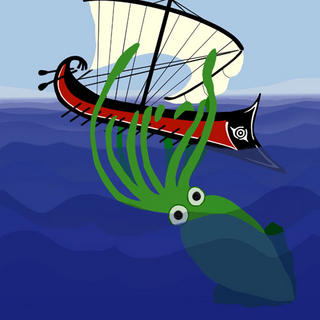
In the first painting i have taken liberties with the ancient Greek galley and the legend of Scylla - i've made scylla a giant squid. I wanted to have a very stylised portrayal of both ship and squid and i'm pleased with how they have turned out.
The eye painted on the boat is still commonly found in Greece and malta and other mediterranean coastal towns where the eye is painted to ward off evil.


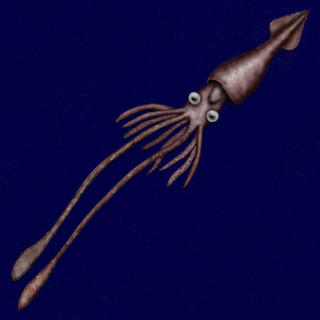
This more realistic version of a giant squid is based on looking at a lot of indistinct photos of very battered dead giant squid , descriptions and calculated guesswork. Giant squid are probably able to change colour and produce sepia [squid ink] and its likely that female giant squid are larger than the males, males probably live longer though. Dead giant squid seem to be whitish with reddish brown areas but that is probbaly not their usual coulour when they are alive.

I actually came across this page while writing this blog entry and it turns out the photo of the squid being examined and prepared for display here is considerably better than any of the others i found.
However, as yet there are no films or photos of the giant squid in their natural habitat.


Update: 27th September 2005

Japanese Zoologists have apparently captured a live giant squid on film for the first time ever - the film was made 09:15 on September 30 2004 and the results have been published now in the British scientific publication; Proceedings of the Royal Society B by Tsunemi Kubodera of the National Science Museum in Tokyo and Kyoichi Mori of the Ogasawara Whale Watching Association.
As yet i can only see online news articles here and here and not the actual reference in the journal itself.

Update 28th September - National Geographic article here
photos of the giant squid are now on the National Geographic website here
A tentacle that was broken off the squid is here


Wednesday, September 07, 2005

Artists for Katrina Relief

Some artists have been donating artwork to charity auctions or selling art and giving funds to various Katrina Disaster relief charities.

The image hosting site Flickr has a Katrina Relief auction page with a variety of works for sale, including a photographic print of Coloured smoke which i think is outstanding.

Some Washington DC art bloggers are auctioning some beautiful artwork

Art for Katrina has a selection of donated artwork that will be sold on ebay . Info about donating artwork here

MissionFish has a huge page of listings on ebay with all sorts of items [books, bags , jewellery, clothes and everything] as well as artworks being sold for Hurricane Katrina Relief charities. MissionFish guarantees that the money gets to the registered charity or non-profit organisation.

Kards for Katrina Relief
are collecting original cards donated by calligraphers, collage artists and greetings card artists and other artists around the world during the month of September. They are then selling raffle tickets at $5.00 each for a chance to win a packet of 5 original cards.
100 percent of the proceeds are going to America's Second Harvest
Raffle tickets: Raffle tickets will be sold through Acorn Arts and you can purchase raffle tickets on line. Raffle draw on 2nd October.

I will be sending a batch of original cards to the Kards for Katrina relief raffle this week . I hope all of these initiatives mean lots of money for the disaster relief fund.

Technorati


Finally La Rentrée

Things have been hectic for the last few days here. My kids have gone back to school later than teh younger kids i mentioned last week as they are now both at secondary school [Collège].

My daughter is in her final year of
Collège so she is an old hand at starting school at 7.50am although after the llazy days of the summer holidays, having to go to bed early and get up early is a shock to the system. Primary school kids start school at 8.30 which still seems early in comparison with Scottish shcools that start around 9am.

My son's new secondary school is in Nice which is a 20 odd minute train ride away from Antibes. Since quite a few pupils travel considerable distances,many travel further than Taran, his school starts later [8.45] to accomodate the travellers. So he leaves the house quite early but at least its not as bad as having to be in Nice for 7.50.

So far he is loving his new school , which is a great relief.

For some strange reason, my daughter's school never hands out the list of requirements untill after the school term has started. This always strikes me as crazy since by the start of the school year the bargains and special offers have ended and the choice has diminished markedly.

I never buy the fanciest folders and jotters - although some people seem to like to colour or brand coordinate everything and spend masses of extra money into the bargain.
I generally buy some of the expected items beforehand, in the hope that they will be on the list - occasionally i've been saddled with unused items but usually i've been able to guess at least some things in advance.

The first weeks of the new school year involve filling in masses of forms , writing cheques and putting covers on school text books - this being something i have never been very good at. My dad was the expert book coverer in our house - its a pity he is in Scotland and can't be press-ganged into helping.


Sunday, September 04, 2005

Illustration Friday -Roots -wild boar sow and piglets

I wasn't sure what to do for the new Illustration Friday topic -Roots.
I wrote a poem recently exploring roots and what ties us to the land we grow up in and i was wanting to do something different. I also didn't want to do something with obvious roots like a plant.

I then thought painting a mole since they live among the roots -but I also thought this might be difficult from the point of view of everything being much the same colour underground.

After that , i thought of roots in terms of a verb - and so it made me think of new born babies who root for milk, and also pigs who spend lots of time rooting for interesting items of food [when they are allowed to roam free.

So this week i have painted a wild boar sow and two piglets. The piglets are learning to root for acorns left from the previous winter.

Wild boar are impressive animals very strong and robust -although apparently they can suffer from sunstroke so they will wallow in mud to keep cool and prevent sunburn.

Recently, wild boar have been reintroduced to Scotland [although they are not allowed to run completely free] since their rooting for food actually helps forest growth by keeping down invasive plants like bracken , the soil is turned by their feet and is fertilised by their manure making them very useful in reforestation projects.

Boar probably became extinct in Britain some time in the middle ages when the were hunted to extinction after their habitat was reduced by extensive clearing of the forest.

Wild boar have become very numerous in the south of France now, they are encouraged by the green corridors which link their traditional roaming areas almost to the sea. They often wreck gardens by eating produce and uprooting everything else so many people are not so keen to see them expanding their habitat.

A couple of years ago , a huge wild boar was found off the coast on top of a piece of wood- its thought the the boar made its way to the sea shore and was swept out to sea by a huge wave.

Then after swimming for a long time, the boar must have climbed thankfully on board the wood but sadly it was already dead when it was picked up by a fishing boat.


Technorati


Thursday, September 01, 2005

Hurricane Katrina

Katrina is a pretty name -my cousin is called Katrina and it seems unbelieveable that hurricanes with almost friendly sounding names can cause massive devastation.

Its hard to know what to do when there are such horrific disasters- especially if you are thousands of miles away. Mostly giving money and raising awareness is the only way of helping, unless you are on the spot.

I've found some places to donate online:


America’s Second Harvest—The Nation’s Food Bank Network


Direct Relief International


American Red Cross

Americares

Convoy of Hope
this charity also accepts paypal donations


These all seem to be decent places to send money - most money goes to the disaster rather than to paying high salaries . I tried to check them out before posting them - most get 4 stars on the Charity Navigator.


Network for Good has a whole page of potential places to donate all in one place securely with details about each charity - plus information about the disaster and activity pages for explaining hurricanes and disaster preparedness to children. Also has pages about volunteer opportunites


Blogs trying to raise funds for Hurricane katrina Relief http://www.truthlaidbear.com/katrinablogs.php

Instapundit roundup page with suggested charities -all denominations and none http://instapundit.com/archives/025235.php


Some additional things that i think deserve poubliscity - Homes for Katrina Victims is coordinating a register for relatively local folk willing to take in people made homeless by the disaster. I wish this effort every success


Americans Aiding Americans is keeping note of donations by groups and companies -some of whom are matching donations made by their customers or employees which might be useful to folk in the US who are considering donating.


Other notable efforts can be found on Michelle Malkin's blog which is where i found the two above.

Technorati